
Fixed-price vs cost-plus building contracts: what is the difference
By Nadia Delgado · Updated 2026-07-13
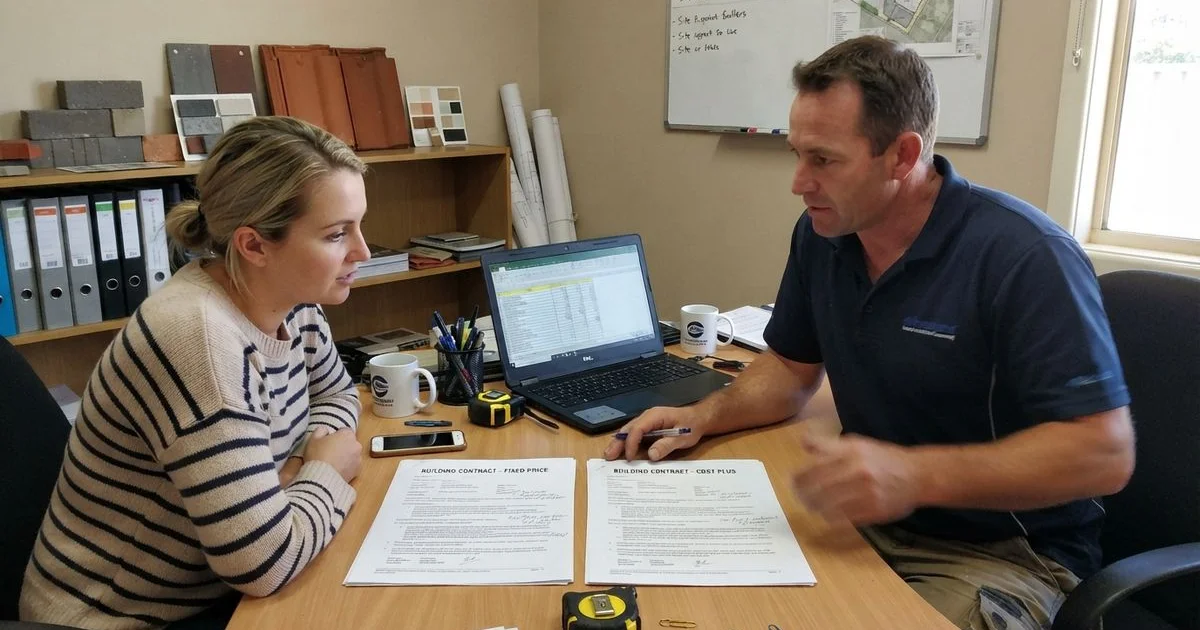
The type of contract you sign changes who carries the financial risk if a build costs more than expected, which makes it one of the more important decisions in the whole process, and one buyers often gloss over in favour of comparing headline prices.
How a fixed-price contract works
A fixed-price contract sets a total cost upfront for the scope of work defined in the contract, including nominated inclusions. The builder carries the risk if their own costs run higher than expected, provided nothing changes on your end. The catch is that most fixed-price contracts still include provisional sums, estimated allowances for items that cannot be locked in exactly, commonly site works, tiling and sometimes driveways. Those provisional sums are not fixed, and any gap between the estimate and the actual cost lands on you.
Fixed-price contracts suit buyers who want budget certainty and are building a reasonably standard design where most costs can be locked in from the start, which describes most volume and display home builds.
How a cost-plus contract works
A cost-plus contract charges you the builder’s actual costs for labour and materials, plus an agreed margin or fee. There is no hard price ceiling unless you specifically negotiate one, such as a guaranteed maximum price clause. This model gives more transparency into where your money is going and can suit highly custom or renovation projects where the scope is genuinely hard to price accurately upfront, since a fixed-price quote in that situation often just bakes in a large contingency buffer anyway.
The trade-off is that you carry more of the risk if costs run over, and tracking actual spend against a moving total requires more attention from you throughout the build than a fixed-price contract does.

Comparing the two directly
| Fixed-price | Cost-plus | |
|---|---|---|
| Who carries cost overrun risk | Mostly the builder, except provisional sums | Mostly you, unless capped |
| Price certainty | Higher | Lower, unless a maximum is agreed |
| Transparency into actual costs | Lower | Higher |
| Best suited to | Standard designs, volume and display homes | Complex custom builds, renovations |
| Watch for | Large or vague provisional sums | No ceiling on total cost |
Where budgets actually blow out
Cost blowouts and disputes over quoted price versus final invoice are among the more common complaints raised about builders, and both contract types can produce this outcome if the details are handled loosely. On a fixed-price contract, it usually comes down to provisional sums that were underestimated or vaguely defined. On a cost-plus contract, it usually comes down to no ceiling being agreed, combined with limited visibility into costs as they accrue. Either way, the fix is the same: get provisional sums itemised and capped where possible, and if you are on a cost-plus arrangement, ask whether a guaranteed maximum price is available.
Which one should you choose
If your project is a standard design on a straightforward block, a fixed-price contract with tightly defined provisional sums gives you the most predictable outcome. If you are doing a highly custom build, a major renovation, or a project where scope genuinely cannot be nailed down yet, a cost-plus contract with a negotiated maximum price can offer a fairer balance of transparency and protection. Either way, read the contract closely and ask your builder to walk through every provisional sum or open-ended cost line before you sign, since building contracts involve significant financial commitments that are worth getting right the first time. For typical per-square-metre figures across finish levels, see our guide to what building a new home costs in Perth.
Questions to ask regardless of contract type
Whichever structure you sign, ask how variations are priced and documented, since this process matters just as much as the base contract type in determining your final cost. Ask what happens if a provisional sum item comes in under budget, since some contracts return the difference to you and others do not specify, which is worth clarifying rather than assuming. It is also worth asking how often the builder has needed to invoke a variation clause on recent, comparable projects, since a builder who rarely needs to can usually explain why their initial scoping is more accurate.
A note on mixing the two models
Some Perth builders offer a blended approach: a fixed price for the bulk of the build with a small number of named items, often site works or a specific finish, priced on a cost-plus basis with a stated cap. This can be a reasonable middle ground if your project has one or two genuinely unpredictable elements sitting inside an otherwise standard build, provided the split between fixed and variable components is spelled out clearly rather than left informal.
See our methodology for how we assess builders on this site, or visit the homepage to browse builders by category.
Questions people ask
- Which is more common in Perth, fixed-price or cost-plus?
- Fixed-price contracts are more common, especially for volume and display homes. Cost-plus arrangements show up more often on complex, highly custom or renovation projects where scope is hard to pin down upfront.
- Can a fixed-price contract still cost more than quoted?
- Yes, if it includes provisional sums or if you request variations during the build. A fixed-price contract limits risk on the items it actually fixes, not on everything in the project.
- Is cost-plus always more expensive in the end?
- Not necessarily, but it carries more uncertainty since you are paying actual costs plus a builder's margin, without a hard ceiling. It can work out cheaper on a well-managed project or more expensive on one with lots of unforeseen issues.
- Can I negotiate a cap on a cost-plus contract?
- Some builders will agree to a guaranteed maximum price on a cost-plus arrangement, which limits your exposure while keeping the cost-plus transparency. It is worth asking directly if this option is available.